



Our Behind the Guide Series is a chance to take a deeper look at waterfowl guides from across the country whose passion for this lifestyle is unrivaled, unbroken, and downright obsessive. Each of these guides also carries with them a tool. One that many would also consider unrivaled, regardless of the model, color, pattern, or age. A Browning shotgun. Browning Firearms has been around since the late 1800s, and over the course of that time, their firearms have been the top pick for hunters in many pursuits. Including their shotguns among many waterfowl hunters. From the prairies of Canada to the timber of Arkansas, guides and hunters alike have relied upon & trusted the famed ‘golden trigger’ season after season.

We’re back again with another Behind the Guide Series interview, and this time, we’re sitting down with Rusty Creasey, Arkansas native and legendary waterfowl guide. To get a glimpse into the life of Creasey, we talk about land management, Arkansas duck hunting, and his favorite shotguns to chase ducks with.
Split Reed: Who are you, and what do you do?

Rusty: “I’m Rusty Creasey, and for the past 20 years, I was the manager of the famed Coca-Cola Woods. Working to take it from a good place to a great place. The Coca-Cola Woods are very well known. In my journey, however, I decided that I needed to continue to grow, spread my wings, and try something different. I am now the manager at Fowler’s Point in Des Arc, Arkansas, where I now manage about 3000 acres of diverse duck habitat.”
Split Reed: Did you grow up with a hunting background when you were a kid?
Rusty: “Yes, absolutely. From the time I was big enough to go outside by myself I was shooting pellet guns and hunting small game. I remember I killed my first rabbit by myself when I was in the third grade. My grandmother cleaned it. I remember it like it was yesterday. I always hunted and fished when I was outside for as long as I can remember. When I got to where I could leave the house and ride a bike out somewhere, I would take my fishing rod and fish any pipes or any little ponds around the house that I could go to. The only time we were in the house was when it was dark or raining outside. Hunting, fishing, playing basketball, that was pretty much life growing up.”
Split Reed: What was your introduction to waterfowl hunting?

Rusty: “My uncle Harvey Shoe was the manager of the Coca-Cola Woods for 40-plus years. I had an older brother, Mike, who was 15 years older than me, and they were both huge waterfowlers and involved at the club. Any time they had a preaching or didn’t have guests to entertain. They would take me, and they really got me into waterfowl and just the whole experience. From calling ducks to learning how to work with people, just every aspect of waterfowl hunting. Setting up, calling ducks, handling a shotgun, leading ducks, you know, all that stuff. They were instrumental. First of all, for taking me and spending time with me, but second of all, teaching me the right way to do all those things.”
Split Reed: From the moment of your introduction to the sport, what were some of the formative steps that got you into the headspace that you’d want to be a guide and manage duck habitat for a living?
Rusty: “Obviously, just the passion for the outdoors and for waterfowl. I had it in my mind that if there was ever a way I could make a living doing something I love, I was going to try to find a way to do that. Watching my uncle have success doing that, and him being a successful dog trainer, really helped drive me in my pursuit. I enjoy being around people, and I feel like I handle people well, so the social aspect was great. Honestly, it’s never been about the money. Making a living was all it was ever about, not trying to get rich. I wanted to do something I loved, do a good job at it, and make people proud. That has always been my goal. My dad always had a saying, ‘It doesn’t matter if you shovel horse manure, you be the best at it that you can be.’ So whether it was sports in high school, being a land manager, or running a duck hunt, I always wanted to put my best foot forward. I want to be the best that there is at it, and I’ve always had that attitude. So far, that’s seemed to have served me well, and through networking and good relationships, I was able to somehow end up where I am today.”
Split Reed: What has being a guide and or a land manager taught you about yourself or life in general?
Rusty: “I think what it’s taught me is that no one, even the owners of the property, appreciates it as much as you do. They want to appreciate it, but they can’t have a true appreciation of it unless they’re out there with you on those hot days, fighting cottonmouths, swatting mosquitoes, getting covered in mud and sweat and thorns, or whatever it may be. Unless you’ve gone through all that, I don’t think you ever really understand how passionate a caretaker/manager is about a piece of property. Not unless they’ve been in the trenches with you. And while that’s not their job as an owner, I don’t think they can fully understand and appreciate the whole experience.

It’s a lot of work from the time you do the food plots, clean out the ditches, dig out the pipes, and clean out beaver dams until the season comes around, and you get to pull that gold trigger. There are a lot of steps to get you that trigger pull, and it’s hard for someone to appreciate everything that goes into that unless you’ve done it.”
Split Reed: In a broad sense, what does boots-on-the-ground management look like for you with a property?
Rusty: “Managing water on the land is only a small part of the puzzle. Draining water from your moist soil units produces natural seed. Which oftentimes is not as simple as opening a pipe. You may have to clean a beaver dam out of the end of that pipe almost every day to ensure that it drains.

From there, it’s working the land and, where you can, planting food plots. It’s developing new hunting holes. It’s maintaining levees and water control structures and brush hogging, cleaning out holes and any trees that might’ve fallen. There’s just a vast array of different things, and if you’re not out there physically laboring and doing it, you’re thinking about doing it.
You’re planning. There’s a method to the madness. It’s creating a plan and figuring out, okay, we need to designate this soil as a rest area and make sure we don’t hunt here. Or maybe we need to access this area from this side instead of going through the middle of our ducks. So there’s always planning going on, and it’s a 365-day ordeal. You may not be in the field working every single day, but on the days that you’re not working, you’re scheming and planning. Getting your game plan together as far as what’s the most effective way to get where you need to be without disturbing the birds.”
Split Reed: Whether you’re guiding or hunting for yourself, what Browning Guns do you hunt with?

Rusty: “I’m a huge fan of the Citori. So if it’s me and just a couple buddies, or me and maybe a small group, and we’re in a real tight timber hole, we’ll shoot .410s or 28 gauges. I rely heavily on my little .410 Citori. As we get to a little bigger duck hole, I love my 20 gauge Citori. It’s just so dependable, day in and day out. It’s been reliable and a pleasure to shoot. But as the season wears on and ducks get a little more leery, maybe they don’t fully commit. Or, as you know, if we happen to hunt an open field or a tree line, then I’ll go to the Maxus II.

The Maxus II fits me, it fits me really well, and it’s just a reliable shotgun. Anybody that’s in my circle will tell you I don’t clean my guns nearly as often as I should. This is no lie. I’ve shot my Maxus all season before, and the closest I got to cleaning it was dropping it in the water a couple of times on accident and then squirting a little oil in it as I was walking out to go hunt the next morning. As a guide, you’ve got the equipment that you count on, and to me, a shotgun is no different than a boat motor. When I hit the key on that motor, I need it to crank, and when I pull that gold trigger on that shotgun, I need it to go bang. I need it to cycle, and I need it to run. My Brownings have always withstood the test of time for me.”
Split Reed: Sub gauges are fun to shoot; I feel like you’re also very well known for shooting ducks with things that are not shotguns; could you give me the rundown on that?
Rusty: “So years ago, one of the very first times I was ever videoed on a hunt was the old Echo Duck Calls DVDs, and then later on, on YouTube with Freddie King and Echo. With public land getting a little more popular back in the day, Freddie and his brother used to go to a public land spot—the limit was two at the time—and they would shoot their two ducks a piece, and then they would leave. That kind of sparked an idea for us. As a manager, you want it to be fresh for the owner, but also, as a duck hunter, you want to hunt, obviously. So, on the days that the owner wouldn’t duck hunt, we started taking a bow and arrow. That allowed us to get our duck hunting fix and have the place still stay quiet. You got to shoot your ducks, but the place stayed fresh because there were no shotguns going off. It’s like we weren’t even hunting the place at all.
I’ll tell you, shooting ducks with a .410 sounds tough, but if you’ve ever shot ducks with a bow, shooting them with a .410 doesn’t seem that tough anymore. The thing with shooting them with a bow is that you see so much more by bow hunting them than you do with a shotgun. It’s the epitome of finishing ducks. You know, we let them sit on the water, and man, it’s just like bow hunting big game. With a gun, if you see him, you can kill him. But with a bow, everything’s got to be perfect. To shoot four big mallard drakes with a bow in the timber is pretty special.
Last year, I tried out a slingshot and glass marbles. It took me a few tries, but I did kill a mallard drake on the wing, backpedaling. He was about eight or ten feet off the water, right in front of our face, just overhead. I had a glass of marble and a slingshot. I don’t mean no fancy slingshot, I’m talking about a wrist rocket. I shot him right in the bottom of the neck and killed him out of the air with it. I’m sure there’s somebody who’s got a better story than that, but that’s mine. I was as excited as if I’d had shot 150” deer with my bow. That was pretty daggone cool.”
Split Reed: What’s one of your favorite hunting memories with one of your Browning shotguns?

Rusty: “My wife was a school teacher, and she was out of school, but due to having guests every day to run on hunts, she just didn’t get to go with me very often. So when I can get out with her, those days are special. One hunt that stuck out for me happened with my wife, my older brother, and myself. My brother carried my 20 gauge Citori that morning, and I carried my .410 Citori. It was what I would call a little gentleman’s hunt. My wife didn’t shoot, but she loves to go to watch and see the show, and just enjoys the experience. It was a day or two after Christmas, and things had frozen and had thawed out. I said, ‘I think we can go shoot us eight mallards, maybe even a few bonus ducks.’ So my brother, my wife and I went. I shot four drakes with my .410, and then I think I killed a teal or two that morning. But we’ve got a picture of my wife and me from that morning. It was kind of a foggy morning, but it’s just a really, really cool picture. I’ve got my Citori over my shoulder; she’s in camo, and I got four great mallards there, and that’s one that I’ll never forget. We don’t get to share ones like that together very often, so that’s a special one for me.”
Split Reed: What do you look for in the performance of your shotguns?

Rusty: “Well, number one, they need to shoot straight and shoot where you point them, and Browning, without fail, has always done that. The point of impact has always been great. I’ve got a pretty long length of pull—I’m almost 6’ 5”—so I need a long length of pull. And the length of pull is great on a Browning. They just fit me perfectly. A shotgun has to feel good to you. I tell people this: it’s like when your mom gives you a hug, you know, just in your mama’s arms or now in my wife’s arms—it just feels right. Those guns have always just felt right. They’ve felt like home whenever I shoulder them. Fit, feel, and reliability, that’s what really gets me about those shotguns.”
Split Reed: Do you have any tried-and-true shotgun tips that you think people should know about?

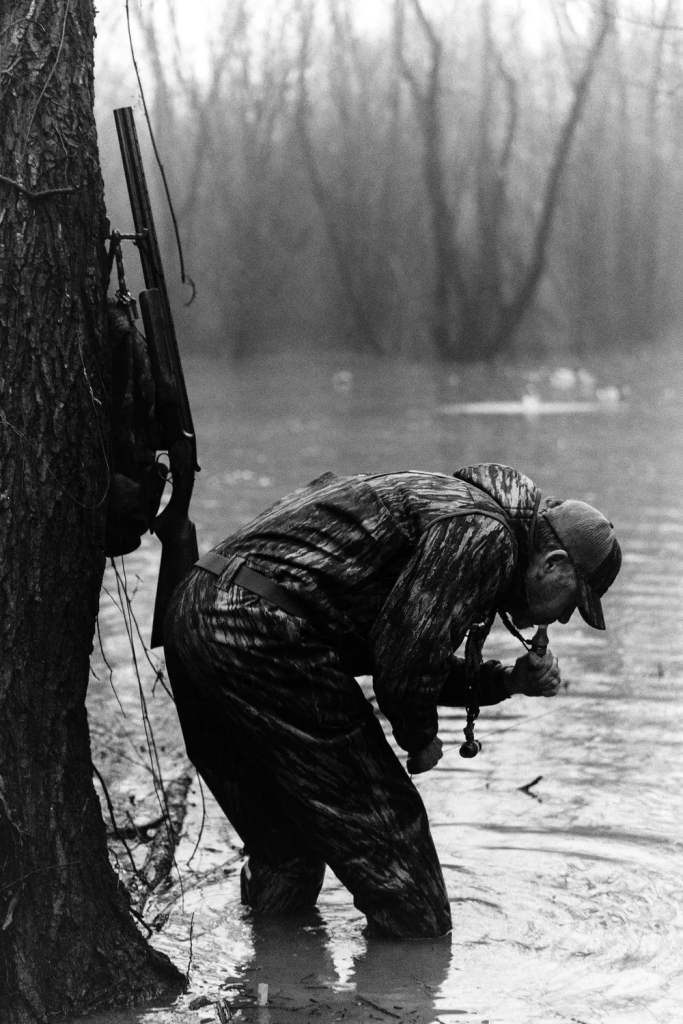
Rusty: “Hunting the timber, everybody’s always looking for an easier way to hang their gun up. And I always will put a zip tie under the rib of my shotgun. I guess the way to describe it would be to put it between the rib and the barrel and then tie it underneath and leave a little slack in the zip tie. I use a black, heavy-duty zip tie. You can hang that on any tree hook or on any tree limb. I’ve got zip ties on all my shotguns, that’s how I hang my gun. Another thing I’ve learned is if you use a gun case immediately after the hunt, take your gun out of the case. Leaving it in that case will promote rust and cause the blueing to come off. If it’s cold, it’ll freeze, and the blueing will come off your gun or the dip. So always take your shotguns out of your case right after the hunt. There’s not a lot of maintenance with a Browning, which is a great thing because they’re super reliable, and they’ll run when they’re dirty.”
Split Reed: As an avid hunter and guide, is there any piece of advice you’d like to share with other waterfowl hunters?
Rusty: “Yes, one would be, if at all possible, don’t wear bulky gloves when you’re shooting. It can be such a safety issue. I’ve had guns go off before because people are so worried about their hands being cold and wearing big gloves. If you have to wear big gloves, at least keep your shooting hand without a glove or a thin glove. One, you’ll be more accurate, but also, it’s a lot safer without those big gloves. Firearm safety is super important, especially as a guide hunting with a big group of guys. Keep your gun pointed up and always double-check guns as you’re loading a boat up or as you’re putting guns up. There’s no harm in double checking guns, several times I’ve checked guns that were allegedly unloaded and found ammo in them. My daddy and my brother just ingrained firearm safety into me. You know, treat every gun as if it’s loaded, point it in a safe direction, the basic safety stuff is always worth mentioning because it’s important. Growing up handling guns, you assume everybody knows that, but a lot of people didn’t have that kind of upbringing.”
Split Reed: In your own words, how would you describe the relationship between a waterfowl hunter and their shotgun?

Rusty: “I feel like my number one tool may probably be my duck call, but my gun is a close second if not a tie. It’s something that you have to be able to rely on. It’s your right-hand man, and without it, what are we doing? Your gun has to be like your best friend; you just have to be able to count on him when you need it.”
Split Reed: As waterfowl hunters, we are all big gear junkies, and we love to go back and forth with each other about what we like and what we don’t like when it comes to gear. I think this is very true, especially when it comes to shotguns. Based on your experience, if someone came to you debating on pulling the trigger on a Browning versus a different brand of shotgun, what would you tell them?

Rusty: “I’d say it would go back to, what did you grow up shooting? What did you learn to shoot on? In other words, if you shot your granddaddy’s old sweet 16 humpback, then I’m gonna say you go with an A5. If you grew up shooting a pump or entry-level semi-auto, then I would encourage you to shoot the Maxus II because that will fit you the best. If you grew up shooting an over-and-under, then the Citori is gonna suit you well. But if I could only buy one shotgun to hunt with the rest of my life, as far as shooting ducks, geese, dove hunting, small game, turkeys, etc. If I can only have one gun, then I’m gonna take the Maxus II 12 gauge, and I’m gonna be just fine.”
Split Reed: What’s on the horizon for you and for Fowlers Point this year?

Rusty: “What’s exciting about Fowler’s Point is that it’s so diverse. We may hunt in buck brush, we may hunt a tree line, in big willow trees, or we may hunt in a timber hole. So, having the different options as far as gauges/guns go really fits me well down there. Each day, I can adapt and pick a different gauge to fit the situation. I’m really excited to develop and have a huge canvas to paint with now and keep growing. We’ve got high water coming, so we’re going to have lots of water and lots of options as far as where to hunt, and hopefully that means lots of ducks.”