

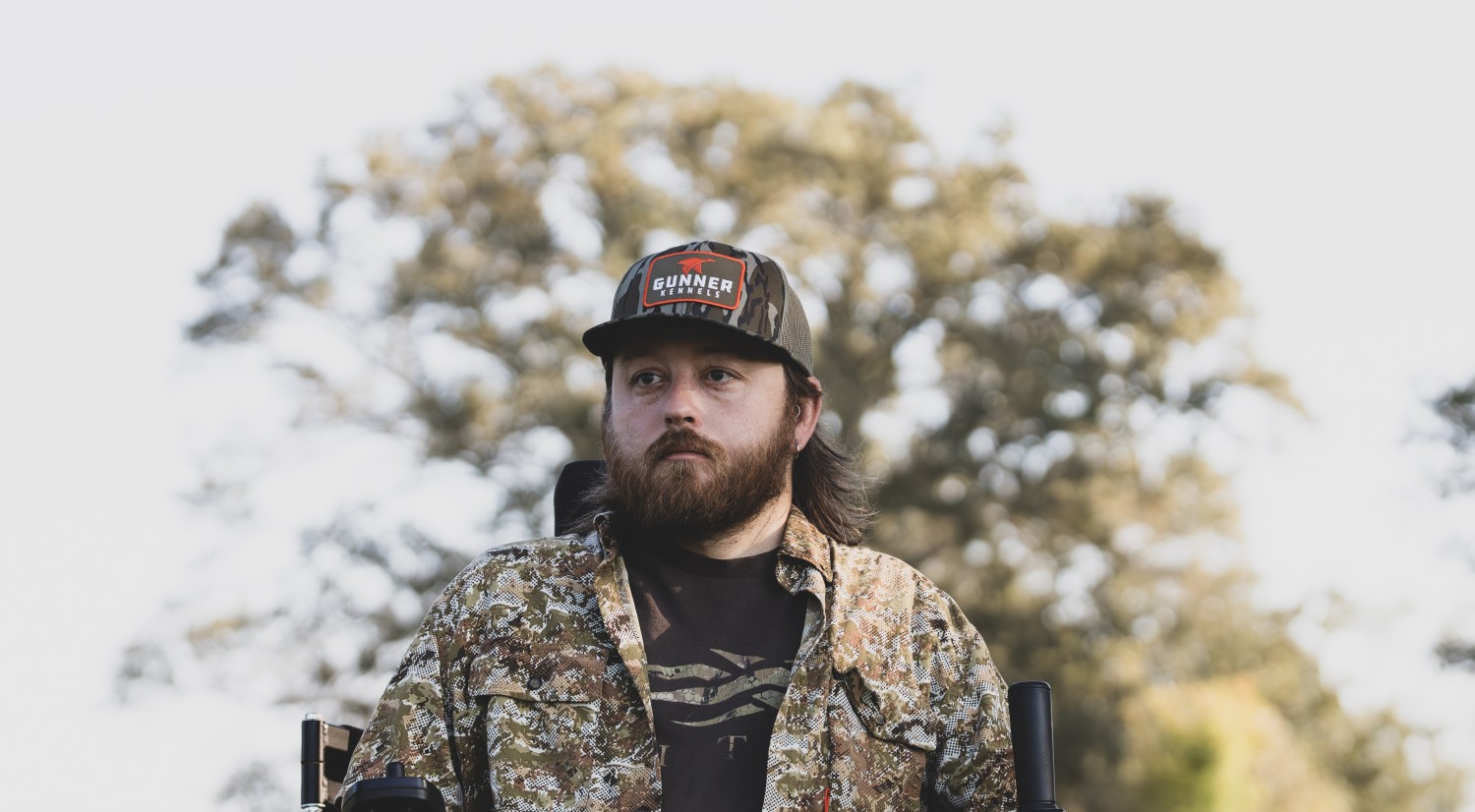

Faces in Turkey is a series that features contributing members of the turkey community at large, ranging from creatives behind lenses to artisans carving turkey calls and teaching the next generation. Each person in the spotlight has their own story to tell, whether they are well-known figures or those operating below the industry’s radar. These are the men and women who have dedicated their lives and work to turkey hunting. These are the stories that makeup Faces of Turkey.
There are key moments in life where collective contributions are truly impactful or groundbreaking for numerous people in the world. Each individual niche has its own unique moments. For the turkey hunting world, the release of the upright hen decoy from Dave Smith Decoys in 2008 changed the course of hunting the “King of Spring.” In this Faces of Turkey, we sit down with Brad Cochran, general manager and former co-owner of Dave Smith Decoys (DSD), as we explore their venture into the turkey decoy creation process.
Split Reed: How did Dave Smith Decoys get started?
Dave Smith Decoys began as a one-man show nearly three decades ago in the small town of North Plains, Oregon, just west of Portland. At the time, Dave had never made decoys before but was a talented wildlife artist with experience as an industrial sculptor, designing shoe models for both Nike and Fila. He had never intended to start up a decoy business, but a series of events unfolded that would ultimately push him in this direction. While working at the local Fila office in Portland, the company gave his office an ultimatum: either work from the corporate headquarters in Italy or get laid off. Having no desire to move abroad, Dave’s only path forward was to choose another line of work. He was an avid goose hunter at the time with a strong desire to hunt with a decoy that was suited for the small Canada Geese that he was hunting near home. He envisioned a decoy that was lifesize and realistic enough to finish geese all season long. But there were no such options on the market, so he decided to put his skills to work and take a stab at making his own.

The year was 1998. Dave decided to model his first decoy after a Taverner’s Canada goose, a bird nearly identical to a Lesser Canada and one that is common in the Willamette Valley, where he was hunting. His first pose was a beautiful Rester with ultra-fine details, including the separation of the tail and primary wing feathers, a first of its kind. He then added three more lifelike poses and a wind-activated motion system, another first of its kind on a full body decoy and one that every major decoy brand has since adopted. At this point, Dave had created a full line of the first ultra-realistic, “lesser sized” full-body decoys but had done it solely for his own hunting and that of his close friends. But news of the success that he and others were having with them started spreading, and pretty soon, there were a lot of people who wanted to get their hands on his decoys, and I was one of them. With demand rising and bills to pay, Dave decided to dive into building and selling his new decoys. So he cashed out his 401(k), purchased a rotational casting machine, set up a shop in his garage, and sold the first DSDs in 1999.
Split Reed: How did you get involved with DSD?
I first caught wind of all of this in 2000 when I was finishing up a business degree at Oregon State University. I recall that a friend had told me about this guy, Dave Smith, who was making these super realistic decoys up near Portland. When he mentioned that my goose-calling idol, Tim Grounds, had purchased decoys from Dave, I knew I had to see them for myself. As luck would have it, I would soon have the privilege of meeting Dave through a mutual friend, and I was immediately blown away by the quality of his decoys and admired him for being such a humble, down-to-earth guy with so much talent. Soon, we became friends, sharing a passion for goose hunting, decoying geese, and shooting bands.

Not long after that, we started a guiding business together, mainly to support our shared passions. However, guiding goose hunts wasn’t a sustainable career for either of us, and through showing so many other hunters how effective Dave’s decoys were, we created more demand for them. So we decided to join forces in hopes of building up what Dave had started into a full-scale decoy brand. We rented a small shop in Lebanon, Oregon, where I was to handle orders and oversee a small production crew while Dave was responsible for designing new products and building molds in his studio. It’s funny to look back and realize that Dave, who is older and wiser, trusted me, a 23-year-old kid who was fresh out of college, to run a shop and make important decisions. But he did, and by some small miracle, it has worked out, and here we are today.
Split Reed: When were the first turkey decoys released?
We released our first turkey decoy, the Upright Hen, in 2008. Nobody had ever offered a decoy of her kind, so we weren’t sure how she would be received. However, her success was overwhelming, and soon, our customers wanted a gobbler decoy, so we released our ¾ Strut Jake decoy in 2009. The following year, we released our Feeding and Submissive Hens, and in 2011, we added our first Strutter decoy. Since then, we have added a new turkey pose almost every year. Nowadays, I believe we have somewhere in the neighborhood of 15 different turkey poses to choose from.
Split Reed: What goes into choosing a turkey decoy?
The first thing I’d tell someone about choosing a turkey decoy is not to overthink it. There are many poses to choose from but if you just follow some basic tips then you almost can’t go wrong. Some things you should think about before you buy a decoy are your hunting style, method and location.
So first, what’s your style? If you run and gun, then you should consider a single, compact decoy for ease of carry and quick deployment. In this case, I’d look into getting a hen first. If you don’t mind hauling a second decoy around or have a friend who will do it for you, then I would recommend adding a small gobbler decoy. The Mating Hen and ¾ Strut Jake are DSD’s smallest and fastest hen/gobbler combo to set up, which makes them my first choice to run and gun with.

If you’re hunting from a blind then you might think about going with a larger decoy, especially if you are hunting in an open area. A Strutter decoy can be seen from a great distance which makes it an excellent choice in this scenario. Many blind hunters will add additional decoys to their setup too, especially hens, for even greater visual effect and added pulling power.
Another thing that you might want to consider when choosing your decoy(s) is the response you are likely to get when a gobbler approaches. Gobbler decoys generally have greater pulling power but often generate an aggressive response, while hen decoys tend to draw a gobbler in slowly, often in strut. If you aren’t concerned with shooting at a shifting target, then a gobbler decoy can be a rush to hunt with. If you are looking for a still shot for a youngster or an ideal bow shot, then a hen decoy might be the better option.
You might also want to consider the terrain where you hunt. Larger/taller decoys are more visible than smaller/shorter ones in taller grass and gobbler decoys are more visible in darker terrain such as plowed fields for example.
Split Reed: What does the sculpting process look like from start to finish?
I’m glad you pointed out that DSDs are sculpted rather than carved the traditional way, like most decoys are modeled. Most people assume that we use the latter method. The difference is that rather than carving wood away from a block, Dave uses clay to form his finished work. Also, before I dive into my answer, I’d like to point out that I am not a sculptor. I know Dave’s process fairly well from many years of working with him, but he is the hands-on guy when it comes to sculpting and designing every DSD to this day. So, my response to your question is simply my interpretation of his method.

For Dave, the creation process begins long before he touches clay. He will study reference photos and animals in the wild for many months before he begins a sculpture. Once he’s selected a pose and gathered enough reference material, he will plaster his studio with photos of his subject from many different angles. At this point, he is ready to start on the rough shape and size of the body, which can be quite time-consuming, especially if he’s working on a large design. After he has roughed out the shape, it’s time for the toughest part: getting the proportions and the symmetry of the sculpture just right. He struggles with this part the most, sometimes tearing the entire model down and starting over from the beginning if it’s not anatomically accurate. Once he finally has the size, shape, and proportions ready, then it’s time to texture the surface. He then etches every fine little detail into the clay by hand, and at long last, his model is ready to go to the production shop to be molded.
That’s pretty much the gist of Dave’s sculpting method. I make it sound like an easy, straightforward process but Dave has been through this drill more than a hundred times and it requires a great deal of time, energy, focus, commitment, patience and skill just to finish a single DSD model.
Split Reed: What does the field testing process look like for DSD?
When we design a new decoy, our number one priority is to make it the most effective decoy possible. That means before we release a new pose, we must hunt over it extensively. When I say “we,” I mean us, members of the DSD team who are involved in every aspect of our company. We also put decoys in the hands of our trusted partners from across the country, and from there, we compare notes. We focus much of our efforts on the birds’ reaction to the decoys and then make tweaks where needed so that when we’re ready to release a pose, it’s dialed in according to Mother Nature.
Split Reed: How did the development of the A.C.E. Technology come about?

DSD developed A.C.E. Technology in response to customer feedback following the release of our turkey line. Soon after the drop, it became apparent that gobblers were working so close that decoys were often getting hit with stray shot and, in some cases, even full patterns. Our original turkeys were cast from a hard plastic that was durable enough to haul around but too brittle for a shotgun pattern or stray broadhead, so we kicked it into high gear to engineer a highly durable alternative. After many painstaking hours of trial and error, we had created a soft, high-impact urethane plastic that could easily withstand the impact of a magnum turkey load at close range, and the paint adhesion was unreal. We started out by calling it “Advanced Crosslink Elastomer” and then switched to the acronym “A.C.E. Technology” for short. That was back in 2010, and to this day, it is the greatest breakthrough in durability that DSD has ever made.
Split Reed: A couple of years ago, Dave Smith Decoys partnered with MeatEater. How has that partnership played out?
Steven Rinella and some of the MeatEater crew had been hunting over our turkey decoys for several years before they approached us. In 2023, they made us an offer to buy the brand, and at first, we were quite leery, but the further the discussion went, the better we felt. Ultimately, we reached an agreement that included keeping our entire crew intact while continuing to operate out of our same manufacturing shop in Lebanon, Oregon. During the acquisition, everybody who had been working for DSD was onboarded, including Dave and myself, and we’re now happily working for MeatEater while running the DSD brand pretty much exactly like we were beforehand. The people at MeatEater have been really good to work with, extremely supportive, and have taken a hands-off approach. They trust that we are the experts at what we do, and that has formed a really great partnership.
Split Reed: Tell us about the conservation ventures DSD has partnered with.
MeatEater has really encouraged DSD to expand beyond the decoy business by aiding in wildlife conservation. Since the acquisition, DSD has partnered with agencies across the country, both to raise money to fund projects and to provide decoys that are used in the field to capture and study live birds. On the fundraising side, we generate money from the sales of our Limited Edition Series. The program involves building a limited run of decoys that tie to a certain project and then giving a portion of the proceeds from the sale to that project. Our first Limited Edition Series was a smoke phase hen decoy that we sold to raise money for Eastern wild turkey research by Dr. Mike Chamberlain at the University of Georgia. Since then, we have released a handful of Limited Edition Series decoys every year and will continue to do so moving forward. The program is good for both wildlife and customers who value something truly unique.

We have also worked closely with the Alaska Department of Fish & Game on several projects over the last year. Most recently, we have helped the department on a banding project for Emperor Geese. The Emperor Goose has always been a small local population in coastal Alaska, but in recent years, the near-threatened species has experienced an alarming decline. In an effort to determine what factors have led to this decline, Alaska Department of Fish & Game biologists have been actively banding Emperor Geese for years, but have struggled to capture the birds using traditional methods, which is where our decoys come into play. In 2024, DSD was contacted by an ADFG biologist and asked if we would paint a batch of Emperor Goose decoys for them to use in attracting live birds to capture sites. We agreed, and they’ve been using the decoys with exceptional results.
DSD has also partnered with ADFG on banding projects for Taverner’s and Lesser Canada Geese, both on the birds’ Alaska breeding grounds and the wintering grounds here in the Pacific Northwest. Using our Lesser Canada goose decoys, ADFG has successfully lured geese into sites where the birds are captured using a rocket net, banded, and then released. As with the Emperor Geese, this project has been widely successful. Recently, I was fortunate enough to participate in one such capture, and it was both fun and incredibly rewarding!
Split Reed: What have been some highlights of the Dave Smith Decoys brand?
DSD has set the bar in many categories, so I consider every new release to be a highlight. But if I had to choose, I’d argue that our greatest one to date has been the release of our turkey decoy line. Like many of our new releases, turkeys were a game changer to many in the hunting community, but what was unique about this release compared to other DSD launches was the impact that it had on our business as a whole. Turkey decoys catapulted the trajectory of our company in a way that no other decoy has and enabled us to offer the broad assortment of decoys that we produce today.

Prior to 2008, DSD only offered goose decoys, and while they were in high demand, the seasonality of having only one product line created challenges when it came to paying the bills year-round, and those struggles changed when we released our turkey line. No longer were we relying on one source to get us by year-round. Now, we had a hot seller during a period on the calendar that had historically been our toughest time. Turkeys gave us the big boost that we needed at a critical time, which ultimately paved the way to where DSD is today.
Of course, it would be impossible for me to discuss the addition of our turkey line without mentioning the huge impact it has had on turkey hunting over decoys. Before our release, you could not find an ultra-realistic turkey decoy that was both durable and affordable. If you wanted realism, then your only option was to go with taxidermied decoys that did not stand up to the weather or attacks from aggressive birds, plus they were too costly for the average hunter. Alternatively, if you chose to go with a decoy that could take some abuse, then you had to make a huge sacrifice in realism and effectiveness. DSD was the first to offer a turkey decoy that checked all of the boxes. For the first time, a hunter could witness the excitement and effectiveness of using a highly realistic decoy that would last for many years for a fraction of the cost of a mounted decoy. Soon after the drop, the testimonials came flooding in from hunters all over the continent, from seasoned hunters to beginners, young and old, stories of longbeards charging in, attacking, mounting, and strutting in tight circles to their DSDs. Hens fighting, pecking, feeding, and laying down beside their DSDs, kids posing behind their first bird with a proud parent and DSD by their side, and countless stories of heart-pumping new memories from our customers with their new decoys. These stories and all of the ones since are what motivate and inspire us to continue forward.
You can see by my ramblings that it would take forever for me to cover more of DSD’s highlights. So to summarize just this one, turkey decoys launched our business and became one of the greatest breakthroughs the decoy market has ever seen. That is why I believe they are DSD’s greatest highlight.
Split Reed: Are there any special projects or product releases people can keep their eyes open for in 2025?

Yes. The 2024 release of our ACE Mallards was a huge hit, but demand was incredibly high, and very few customers who wanted them were able to get their hands on the new decoys as a result. In the meantime, we have been working on a project that we are really excited about and hope that it will ease the disappointment of the many who were unable to add ACE Mallards to their spread last year. As of right now, things are looking good for a 2025 release, so keep an eye out for it!
Split Reed: What would you say to the skeptics who doubt the usage of turkey decoys?
I strongly encourage the doubters to keep an open mind about decoys and to just give them a fair shot. There have always been hunters who say that decoys flat out don’t work or don’t work in areas where they hunt, yet DSD has customers who’ve had great success with their decoys in literally every state and province where turkeys are hunted. Others will say that decoys aren’t suited to their way of hunting, but that doesn’t mean that you can’t try a new approach. Sometimes, you have to learn HOW to use them successfully, and that might require making some adjustments. Using decoys can not only increase your success but also bring a whole new level of excitement to the turkey hunting experience. However, you will never know if you don’t try!
Photos courtesy of DSD. Dave Smith Decoys can be found at their website www.davesmithdecoys.com or on social media at @DaveSmithDecoys.