

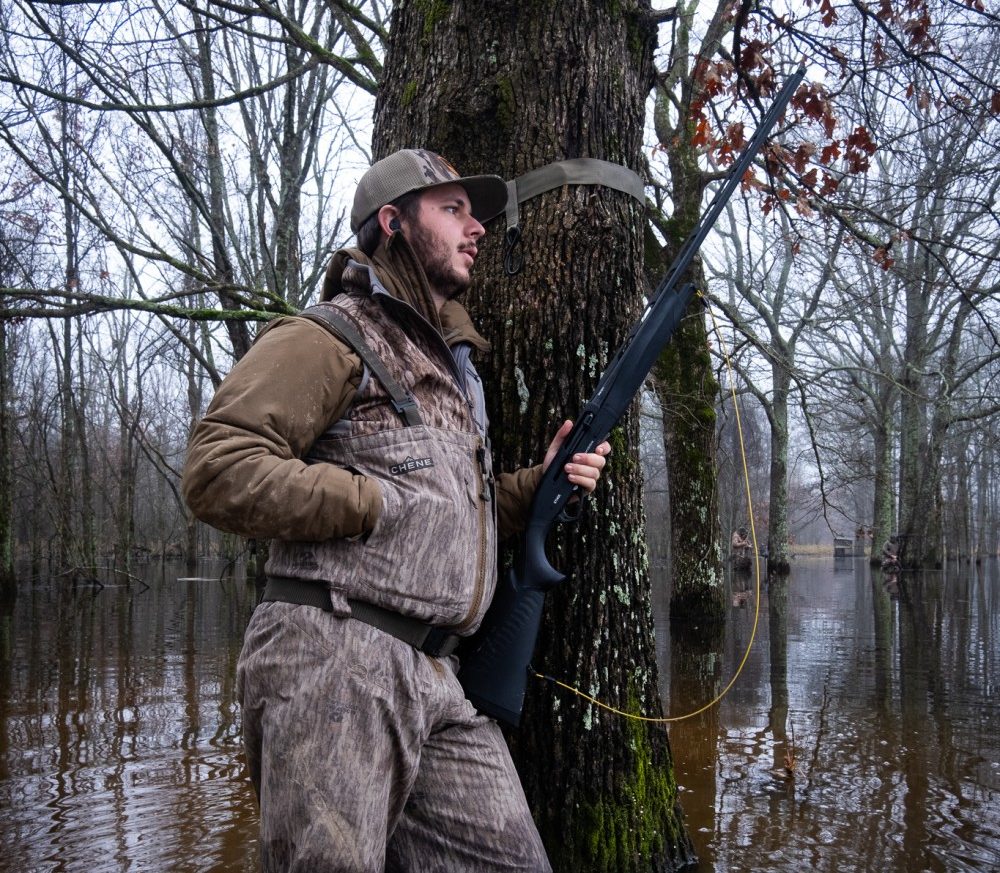

Every year, the best goose callers make their way to Easton, Maryland, for the annual World Championship Goose Calling Championship. Filled with stiff competition. The field undergoes three rounds of competition where a champion is crowned. After a competitor wins three years, they are retired from the competition.
This year, John Walls set out to make history after his wins in 2022 and 2023. Walls, a Delaware native, was closing in on becoming the first contestant to win three consecutive contests with a short reed goose call. When the dust settled, and the winner was announced, John Walls had done it. Crowned champion, Walls had won three contests in a row and written his name in goose calling history. After speaking with Walls after his win in 2022, we couldn’t wait to sit down to learn more about his 18 years of competition and his recent success at Worlds.
Split Reed: First off, congratulations on this year’s win. Last we spoke with you in 2022, you had just won your first World Goose Calling Contest. How does it feel to be here now with three wins under your belt?

Walls: Throughout my years of competing, I always had the thought in my head that I think I have the talent and the capability to win the World Goose. To win it for the first time in 2022 and three-peat is just unbelievable and a little surreal.
Split Reed: I know you’ve been competing for a number of years before you won your first contest. What would you say was the biggest hurdle to overcome and be able to stack three wins in a row?
Walls: I can’t pick out one thing in particular, but I just tried to really fine-tune my calling routine. There are a couple of things that I used to do in the past that just held me back a little bit. For me, the last hurdle was I just changed a couple of notes, and it made everything flow just a little bit better, and I think that set me apart from everybody else.
Split Reed: You’re heading into the final round of the World Goose Calling Contest. Take us through how you prepare and what’s going through your head this year.
Walls: After the second round on Friday night, they called me to make the finals, and it was a relief. But, come Saturday, I was a nervous wreck. I knew that if I could blow clean, I probably have a pretty good shot at winning this thing three years in a row, which would make history. It’s been done on a flute and a long reed but never a short reed.
The pressure was on, and I could feel it. I barely even ate anything for breakfast. We went into the town of Easton to get some cream of crab soup. It’s a tradition we always do, and it took everything I had just to get that in me and keep it in me. My stomach was just a knot. Sitting in the auditorium and listening to all the other final rounds going on made it hard for me to concentrate.

I’ve been doing this for 18 years, but there’s still the doubt in my head. I know what I need to do, but can I do it? This year, I practiced quite a bit, so I took a deep breath, concentrated, and acted like I was practicing in my spare bathroom at home, and I let her rip.
Split Reed: You just mentioned the three types of goose calls historically used in this competition. What makes the short reed your call of choice?

Walls: The short reed is the choice of the newer generation callers. It’s much more versatile than a flute or long reed style call. The particular call I use is a Bay Country Call. My specific call is a little bit of a hybrid call, but it is very close to the Kill Gene that Bay Country Calls offers. It fits me well and allows me to pack air into the call. Everybody blows a call differently, and I tend to use bigger breaths with longer sequences. For me, the Kill Gene fits my calling style perfectly.
Split Reed: What was your first goose call, and when did you start hunting?
My first goose call ever was a Sean Mann Eastern Shoreman, which is a flute-style call. Sean Mann is from eastern Maryland, not far from where the World Goose is held, so he’s very well known in this area. Pretty much everyone has an Eastern Shoreman in this area. Pretty soon after, I bought my first short reed goose call, a Buck Gardner Canada Hammer. I think I paid 20 bucks for it at Walmart, and that really got the ball rolling for me.
Split Reed: What is the biggest difference between calling in a competition and calling in the blind to you?

Calling in the blind is all situational. I would say 80% of the time, I don’t do half of what I do on stage. I stick to the basics–clucks, moans, double clucks, quick spits, goosey stuff. But there are certain days when you might only be seeing migrating geese, and if you can go from top to bottom, 100 miles an hour, doing all the fancy trick notes that most other people can’t do will set you apart. It gives you that extra tool in your pocket that can help you harvest some geese in the field.
Split Reed: When you’re working birds, how important is reading a bird’s body language?

Walls: Reading a bird’s body language is everything. Us contest callers sometimes get a bad rap, and while there’s some truth to that, I was a hunter before I was a contest caller. I was fortunate enough to learn from the right people how to read birds. A lot of time, people will overcall or not hit the right notes. It ultimately comes down to experience. The more time in the field, the better you can read birds and will be more successful.
Split Reed: What’s next for you in terms of competing?
Walls: The next competition style for me I can do is the Champion of Champions Contest this year. They hold that every five years, and that contest is for anybody who has won a World Goose Championship. But as far as competition calling at other contests, I might do some here and there. I do plan to contribute to judging and volunteering wherever I’m needed. I’ll still do some of the live and team live stuff at Easton in the future, but as far as the competition style, I hate to say it’s pretty much done for me.
Calling Tactics
Split Reed: For someone who is new to goose calling, what would be your best piece of advice?
Walls: My best piece of advice is to be patient. I know when I was a kid, I expected that in a week or two, I would be the best I could be. That is just not the case. You’re not going to learn this stuff overnight–be patient. One of the best pieces of advice I could give to a new caller is to find somebody local to you and get one-on-one lessons. There’s a lot of stuff on social media nowadays, and it is a great resource, but in-person lessons are the best. You learn from someone who knows what they are doing and can tweak the little things to become a better caller.
Split Reed: What call or cadence should a beginner goose caller learn first?

Walls: First and foremost is the honk. This is the note that is a part of every other note that you will learn on a Canada goose call. Master that before you start trying other notes. Off the honk is the cluck and moan. These are great calls to have in the field. Once you learn the honk, the cluck becomes easy, and then once you learn the cluck, the moan becomes easy.
Split Reed: Does your calling cadence or style change throughout the season?

Walls: My calling style really changes every day. It goes back to reading birds. I judge what the birds are doing and respond accordingly. If they’re quiet, I’ll be pretty quiet, and if they don’t respond to that, I’ll give them a little bit more. It really varies even from flock to flock. Being a seasoned hunter, you can start to pinpoint what they’re going to want to hear based on the conditions of that date. Some days, you see fresh migrators and some days, you’re working stale birds–it’s all situational.
Split Reed: What would you say is the biggest mistake experienced and beginner hunters alike make in the field?

Walls: I think the biggest mistake would have to be overcalling. A lot of people like to blow their goose call, I mean me too. There are times when that works, but there are a lot of times when the best calling is no call. Sometimes, a little bit of flagging or simply sitting still and watching them circle into the decoys is all you need.
Special thanks to Matt Petraglia of Mallard Marketing for the competition images.