

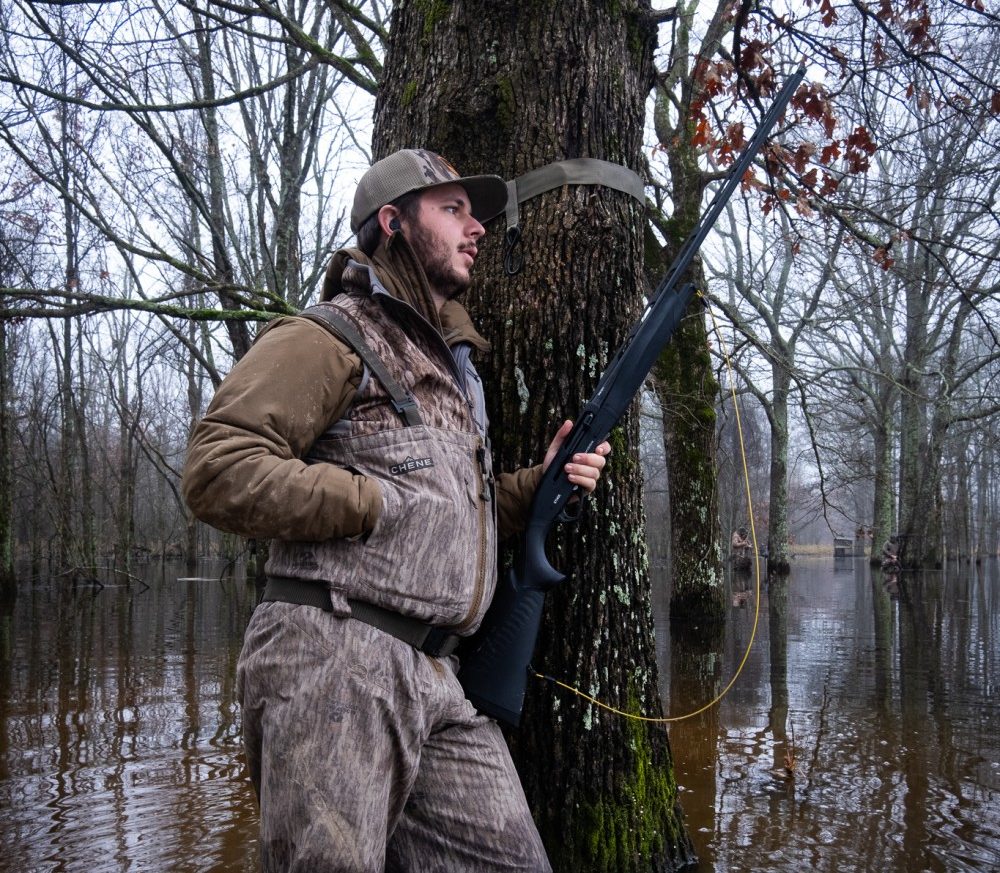

With the recent resurgence of sub-gauge shotguns in waterfowl hunting, hunters are often torn between the old reliable 12-gauge and the lightweight 20-gauge. There are strong cases for both guns. On the one hand, the 12-gauge delivers more pellets downrange and is generally more effective at killing ducks, but on the other hand, the 20-gauge is lighter and softer-shooting. But who’s to say you need to compromise? This season, we split our time between a Franchi Affinity 3 12-gauge and 20-gauge for what we consider the perfect pair of shotguns. In this article, we’ll break down the differences between the guns and explain when and where we chose each one.
The Guns
The Franchi Affinity 3.5 and 3 are budget-conscious inertia-driven shotguns. The “3.5” and “3” signify the shells each shotgun can chamber. Up to 3.5 inches for the “3.5” and 3 inches for the “3”, which, with modern shells, will cover any waterfowl hunting basis. In addition, the Affinity platform comes loaded with features hunters would expect from premium guns, such as oversized slammer buttons, recessed receivers for easy loading, and a slim profile that allows quick mounting and swinging. Best of all, both platforms are affordable, meaning you can realistically own a 12 and 20-gauge for less than the price of other flagship guns.
Both the 12- and 20-gauge models share the same trigger, safety, inertia action, and overall layout. When you’re switching between guns, having the same layout across platforms creates a seamless transition when hunting. You won’t be fumbling for the safety, and mounting and point of aim feel familiar. The main difference between the gauges is weight and barrel length. The 12-gauge weighs in at 6.9 pounds, while the 20-gauge comes in at 6 pounds exactly. In addition, the 12-gauge features a 28-inch barrel, while the 20-gauge has a 26-inch barrel.
The 12-Gauge Workhorse
Affinity 3.5 12-Gauge

The 12-gauge Affinity 3.5 is the workhorse of Franchi’s lineup. It’s a gun for hunters that want uncompromising reliability and the knock-down power to hunt in any conditions. In our lineup, the 12-gauge Affinity played this exact role. If we didn’t know what to expect, this was the gun we chose. If we knew the shots would be deep, this was the gun we chose. If we knew we wanted extra knockdown power, then this was the gun we chose.

A prime use case for the 12-gauge in action was hunting big water this season. While our primary goal was to shoot puddle ducks, this area is where divers, such as the occasional canvasback, are a realistic possibility. The 12-gauge’s 28-inch barrel produces higher muzzle velocity than the 20-gauge’s shorter barrel and delivers more pellets downrange. For that reason, the 12-gauge was our choice for big water and hardier ducks.
While modern shells may steer most hunters away from 3.5-inch shells, the benefit of going with a 3.5-inch chamber is that you always have the option. For waterfowlers, who find themselves in the turkey woods every spring, this gives them the option to shoot 3.5-inch turkey shells for added range and knockdown power. The Affinity 3.5 runs $1,229 in black and $1,329 in camo.
The 20-Gauge Scalpel
Affinity 3 20-Gauge

If the 12-gauge Affinity were a Buck 110, the 20-gauge model would be a scalpel: lightweight, precise, and built for intent. The Affinity 3 20-gauge served us all season as a scenario-specific gun, excelling when mobility, speed, and controlled shot placement mattered most. Compared to a 12-gauge of the same model, a 20-gauge is inherently lighter and optimized around a more efficient payload, rewarding disciplined shooting and thoughtful shot selection. The long-standing debate that “you can kill anything with a 20-gauge that you can with a 12” often misses the point. In capable hands, the 20-gauge delivers clean, ethical performance by emphasizing precision over volume. For that reason, the Affinity 3 20-gauge earned its place in the blind on hunts where agility, balance, and accuracy were the priority.

We always reached for the 20-gauge on walk-in hunts. Often, going further or being quicker than the other guy can make or break a public-land DIY hunt. In this instance, every pound of weight you carry matters. The lighter overall weight and shorter barrel of the Affinity 3 20-gauge were the perfect solution for a mobile duck gun. On public land, a 20-gauge and other sub-gauges are quieter than a 12-gauge. If wary birds are around, shooting a sub-gauge can help reduce the pressure the birds feel and ultimately keep them around longer.

The last instance where the 20-gauge was our go-to gun was for small water hunts. In the right conditions, birds decoying at 5-10 yards is pretty common. While you can shoot them with a 12-gauge at this distance, the 20-gauge provides ample knockdown power without ruining every bird. As hunters, ethically harvesting birds is always a priority, and at close distances, the 20-gauge offers clean kills while still preserving most of the meat. For hunters opting to go the sub-gauge route, the Affinity 3 20-gauge will set you back $999 the black model, and $1,099 for camo.
Final Thoughts on the Perfect Pair
While both 12- and 20-gauge are capable of filling any needs waterfowl hunters may have, there’s no denying that they each have their advantages. For waterfowler hunters, being able to switch between two guns, depending on conditions, will result in higher success and better hunts. If you’re considering adding another gauge to your safe, consider the Franchi Affinity 3. The combination of performance and value makes it an exceptional gun for waterfowlers regardless of budget.