

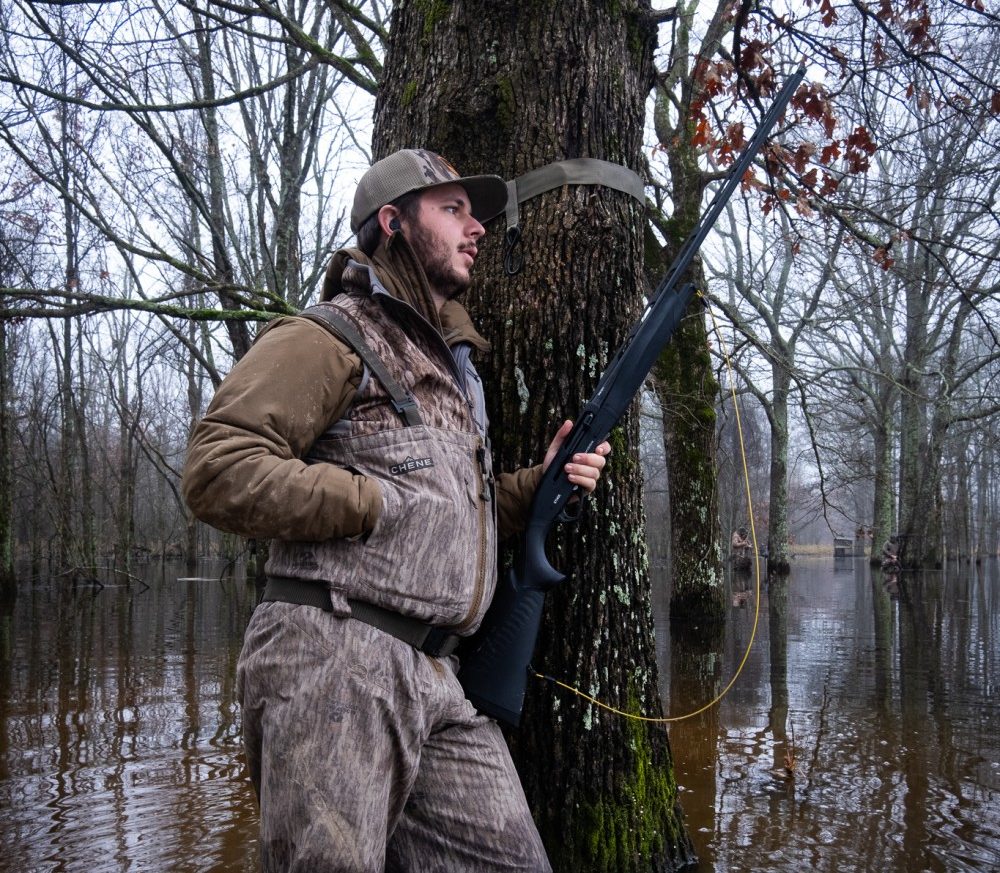

Duck hunting history is as diverse as the places hunters target birds across the United States. From early market hunting to the coastal marshes of the Northeast, every pocket of duck hunting culture has its own history and stories. Yet none may have left as much of a lasting impact on the sport of duck hunting as the timber cuts and bottomlands of the Mississippi Valley. Every duck hunter dreams about standing behind a tree, blowing a single reed call, and watching mallards drop through the trees. It is a sight diehard waterfowlers should all experience, but a sight that may not have happened at all without these greatest timber hunters of all time.
Many considered Arkansas and the bottomland region uninhabitable during early colonization. The dense forests and swampy conditions were less than ideal for cultivating land. Yet, through irrigation and water management, early settlers used the landscape to their advantage, creating rice fields and other agricultural lands. The result quickly attracted ducks and lots of them. Our list consists of call makers, hunters, guides, and writers who put timber hunting on the map and contributed to its lasting legacy. Without these men and women, places like Stuttgart, Arkansas, would not be where they are today. Here are the 10 greatest timber hunters of all time.
Kenneth “Slick” McCollum:

Nicknamed “Slick,” Kenneth McCollum and his family have a long history of duck hunting in Arkansas. After Thad McCollum created the World’s Championship Duck Calling Contest in 1936, Slick soon went on to win it in 1939. But that is only a small piece of his legacy.
In 1947, Slick acquired 1500 acres on the Grand Prarie from his father, Roy O. McCollum (another Arkansas legend). This property would go on to become what is still Kenneth “Slick” McCollum’s Stuggart Hunting Club. Slick opened up this property to hunters throughout the US, meticulously managing the land and guiding alongside his brothers. Slick’s hunting club is still operating today, and the legacy he and his family brought to Arkansas solidifies him in this list.
Chick Major:

Chick Major, known by many as the father of modern duck calling, is as much of a part of Stuttgart’s history as any. While the story of how he made his first call may be up for debate, there is no denying its lasting effects on the sport of duck hunting. In 1945, Chick would win his first ever World’s Championship Duck Calling Championship with his Dixie Mallard call. He and his family would go on to win 28 championship wins, solidifying Dixie Mallard as a major piece of duck hunting history and culture. Chick Major’s work inspired and influenced the likes of many, even mentoring Butch Richenback, who would later go on to create RNT calls.
Nash Buckingham:

Nash Buckingham is one of the most iconic figures in American outdoor literature and waterfowl history. A native of Tennessee, Nash would go on to spend his time waterfowl hunting in West Tennessee and the Mississippi River Valley. Buckingham soon rose to fame through his extensive writing with Field & Stream, Outdoor Life, and Sports Afield. He’d masterfully recount duck and goose hunting along the Mississippi River and its surrounding timber.
Throughout his adventures, he hunted with his legendary shotgun, “Bo Whoop.” This custom Super Fox side-by-side is known for its loud reports and appearances in many of Buckingham’s works. Unfortunately, this gun would go missing for well over 60 years until it turned up for auction in 2009. It went on to sell for just over $200,000, making it the third most expensive shotgun in American history.
Phil Robertson (“The Duck Commander”):

Of anyone on this list, Phil Robertson may ring a bell. Known for his TV reality series Duck Dynasty, Phil Robertson created the original Duck Commander in 1972. Robertson grew up hunting the bayous and cypress forests of Louisiana. While not the legendary timber of Arkansas, Louisiana timber is timber nonetheless. Here, we realized the need for a call that sounded like the real duck rather than a call that would win a contest. Robertson got to whittling until he made the first Duck Commander, and the rest is history. These simple yet effective calls would revolutionize the market, propelling the Robertson family into duck hunting history. To this day, chances are if you walk into a blind someone will have a Duck Commander Call on their lanyard, ready to blow.
Marion McCollum:

The McCollum family has a rich history in Stuttgart, and Marion McCollum’s actions solidified them as part of the Grand Prairie forever. It all began with an addition to his father’s hardware store (McCollum’s Hardware). This addition would soon become Mack’s Sport Shop and would go on to become Mack’s Prarie Wings. A destination for duck hunters everywhere Mack’s carries everything a duck hunter would need. In fact, Remington recognized them as the leading steel shot dealer for 18 consecutive years. Today, Mack’s serves the community of Stuttgart and the hunters visiting as the premiere destination for duck hunters everywhere.
Pat Peacock:

Patricia Peacock, better known as Pat Peacock, is one of the greatest duck callers ever. The step-daughter of Chick Major, she won her first contest at just 12 years old, the Junior World’s Duck Calling Championship. She went on to become the only woman to win both the World’s Championship Duck Calling Contest in 1955 and 1956 and the Champion of Champions in 1960.
Her legacy extends far beyond duck calling, however. Pat later became the first woman to sit on the Arkansas Game and Fish Commission’s board of directors and the Executive Director of the Museum of the Grand Prairie. She dedicated her life to the very thing she loved; as a steward of duck calling and hunting, Peacock would regularly put on clinics teaching the next generation how to blow a call.
Butch Richenback:

If you have ever heard of or blown a Rich-N-Tone (RNT) call, Butch Richenback is the man to thank. Butch found his way into Chick Major’s shop at the young age of 8. Here we went on to live and breathe duck calling, eventually winning the Junior World’s Calling Championship at age 11.
In 1976, after Major’s death, Richenback would finally buy his own lathe and open Rich-N-Tone Calls. These unique and versatile calls instantly rose to the top, solidifying Richenback and RNT as the best of the best. But Butch’s legacy goes much further than creating a call. In his later years of life, he focused on his town and community. He was deeply involved in creating ways for kids to stay active and learn duck calling if they wanted. He was even mayor from 1994 to 2006, helping build Stuttgart into the modern duck-hunting destination it is today.
George Dunklin Jr.:

Another Tennessee native and graduate of Memphis University, George Dunklin Jr., is synonymous with conservation. He got his start managing land soon after graduating when he took it upon himself to manage one of the family farms. Dunklin soon learned just how important the relationship between land management and ducks was. Conservation was key, and there was no greater proponent than George Dunklin. In 2013, Ducks Unlimited made him their 42nd president before later appointing him chairman, as he continued to improve habitats for all ducks, especially those that like flooded timber.
Louis “Red” Wilhelm:

While lesser known compared to the likes of Nash Buckingham, Louis “Red” Wilhelm played a pivotal role in developing the early style of timber hunting in Arkansas. He helped pioneer many of the techniques still commonly used in the timber today. In 1946, Red went on to win the World’s Championship Duck Calling Contest, solidifying himself as part of Arkansas’ rich waterfowling history.
Blake Burris:

Blake Burris better known as Old Man River, has single handedly introduced more people to timber hunting than just about anyone. Burris grew up in Tennessee where he learned the ins and outs of timber hunting. He now runs Ole South Outfitters in Arkansas where he navigates the windy timber cuts and shows people what timber hunting is all about. Burris sports his signature bushy beard and can be found running through the bottoms of the L’Anguille River in Arkansas, searching for greenheads.