


We live in the very best time for turkey loads. When I started turkey hunting in the mid-1980s, there were no screw-in turkey chokes, nor many specialized turkey shotshells. Pattern testing was simple, too. You took a beer can, set it at 35 yards (40 if you gun chambered 3-inch magnums) and shot it. If your gun put 10 holes in the beer can, that was enough to put a couple of holes in a turkey’s head, and you were good to go.
I bring this up to point out that turkey ammunition is so good now that our perspective on what makes an effective load is warped. The ten-hole in a beer-can test was pretty reliable. Now, the best Tungsten Super Shot (TSS) load, fired through the right choke, might put 100 or more holes in that same beer can at 40 yards—that’s both very impressive and it’s overkill.
These days, we are more scientific, and instead of counting holes in Old Style cans, we look at hits inside a 10-inch circle. Experts agree that 100 hits in a 10-inch circle are enough to kill a turkey. Although I like the idea of a 100-hit minimum, field experience tells me 80 hits in the circle are enough, and we have TSS loads that will put three and four times that number of holes in the 10-inch circle. The truth is, if you hunt turkeys the right way, by calling them in close, almost any shell will do the job for you. It’s only if you want to be able to make a long shot, or if you want to hunt with a smallbore, that TSS becomes a necessity. Fortunately, there are good choices in lead available as well. Here is a roundup of the best turkey ammo on the market, both lead and tungsten-iron/TSS shot.

- Best Low-Cost Load: Federal Gold Medal Grand Slam
- Best Value: HEVI-Shot Hevi-13
- Best Long Range: HEVI-Shot Hevi-18
- Best Lead Load: Winchester Long Beard XR
- Best Patterning: Apex Turkey
- Best 20-gauge Load: Boss Tom
How We Made Our Picks
As I mentioned earlier, I’ve been at this turkey-hunting thing for quite a while now, and have seen the evolution of turkey loads first-hand. I have had a chance to shoot a wide variety of lead, tungsten-iron, and TSS loads both at paper and at turkeys over the years. I picked the shells here primarily by how well they patterned, but I also made sure they functioned smoothly in my guns. Surprisingly, some turkey loads don’t, and the last thing you want when you need to make a quick follow-up on a tom is a hull that won’t eject or cycle. The shells here all meet my criteria for pattern, for value, and for function.
Best Turkey Ammo of 2025
Below are our picks for the best turkey loads of 2025 to consistently harvest tricky toms. For our best turkey guns of 2025, click here.
Federal Gold Medal Grand Slam

Key Features
- Available Gauges/Shotshell Size: 3 ½ 10 gauge, 3 ½, 3 and 2 ¾ inch 12 gauge, 3-inch 20 gauge
- Payload: 10 gauge, 1200 fps for No. 4, 5, and 6 shot/12 gauge, 1200 fps for No. 4, 5, and 6 shot/20 gauge 1185 fps for No. 5 shot
- Shot Material: Lead
- Price: $33.99/10 in 3-inch 12-gauge
Grand Slam makes use of the rear-braking Flitecontrol Flex wad originally loaded in Black Cloud steel shot loads. Unlike other wads that separate from the shot as soon as the payload exits the choke, the Flitecontrol Flex design keeps shot inside the wad for the first ten or fifteen feet out of the muzzle, leading to tighter patterns out where the turkey is. Grand Slam also uses high-quality copper-plated shot buffered with ground plastic. The buffer helps protect lead shot as it accelerates and squishes together in the barrel, keeping more pellets round and flying true.
The pattern board definitely shows a difference between Grand Slam and other manufacturers’ unbuffered lead loads with conventional wads. In my guns, it will reliably put 85 hits in a 10-inch circle at 40 yards, while many other lead loads don’t pattern well outside of 30 yards or a bit more. This is a great choice if you don’t want to spend a lot, but you don’t want to let a tom hung up at 40 yards walk away.
HEVI-Shot Hevi-13

Key Features
- Available Gauges/Shotshell Size: 3-inch 12-gauge or 3-inch 20-gauge
- Payload: 12-gauge, 2-ounce loads of No. 6 or No. 7 shot or 3-inch 20-gauge 1 ¼-ounce No. 6 or No. 7 shot 1090 fps
- Shot Material: Tungsten-iron
- Price: $50.99 per 5 in 3-inch 12 gauge, $39.99 per 5 in 20-gauge
The original Hevi13, as its name suggests, was made of tungsten and iron blended to a density of 13 grams per cubic centimeter. That’s much less than TSS (also a blend of tungsten and iron) at 18 gr/cc density, but more than lead at 11.2 gr/cc. It was great stuff.
Hevi13 is back, at least in a “lite” version. It keeps the name “Hevi13,” but it says right on the box that the pellets are 12 gr/cc. While we should, and will, twit HeviShot for this misleading name, the fact is, these are still good shells at half of TSS. The original HeviShot weighed 12gr/cc, and when it debuted in the 1990s, it blew away the lead competition in the woods and at the old National Wild Turkey Federation Still-Target competitions. The pellets are hard and dense, and while they are not very round, they still pattern very well. Sizes 6 and 7 in the new Hevi13 are the rough equivalent of 5 and 6 in lead. You get 278 Hevi12 #7 pellets to the ounce, compared to 220 ballistically equivalent lead 6s. In a two-ounce 12-gauge load, that’s over 100 more pellets you’re sending downrange.
Much of the price of TSS ammunition is due to the high price of raw tungsten. Hevi13 uses less tungsten and more iron, so it costs much less than TSS. If you want performance that’s better than lead but half the price of TSS, Hevi13 might be just right for you.
HEVI-Shot Hevi-18

Key Features
- Available Gauges/Shotshell Size: 3 ½- and 3-inch 12-gauge, 3-inch 20 gauge, 3-inch .410
- Payload: No. 7 shot, 2-ounce at 1250 fps
- Shot Material: TSS
- Price: $94.99 per 5
Dense though it may be, even TSS runs out of energy eventually. You need pellets with enough energy to break vertebrae and punch through skullbones to reliably kill a turkey. Therefore, if you want to be ready for very long shots, you need to find a load that patterns well with “big” 7 TSS shot in your gun, which has much lower pellet counts per ounce than the popular 9s. In my guns, HeviShot’s 3-inch, 1250 fps 2-ounce load of 7s shoots what I would consider killing patterns at 60 yards, and the 7 shot still retain plenty of energy at a range where, on paper anyway, TSS 9s lack sufficient energy to kill every time. Your gun and choke may like a different load, but these would be a great starting place as you experiment with long-range shells.
Winchester Long Beard XR
Key Features
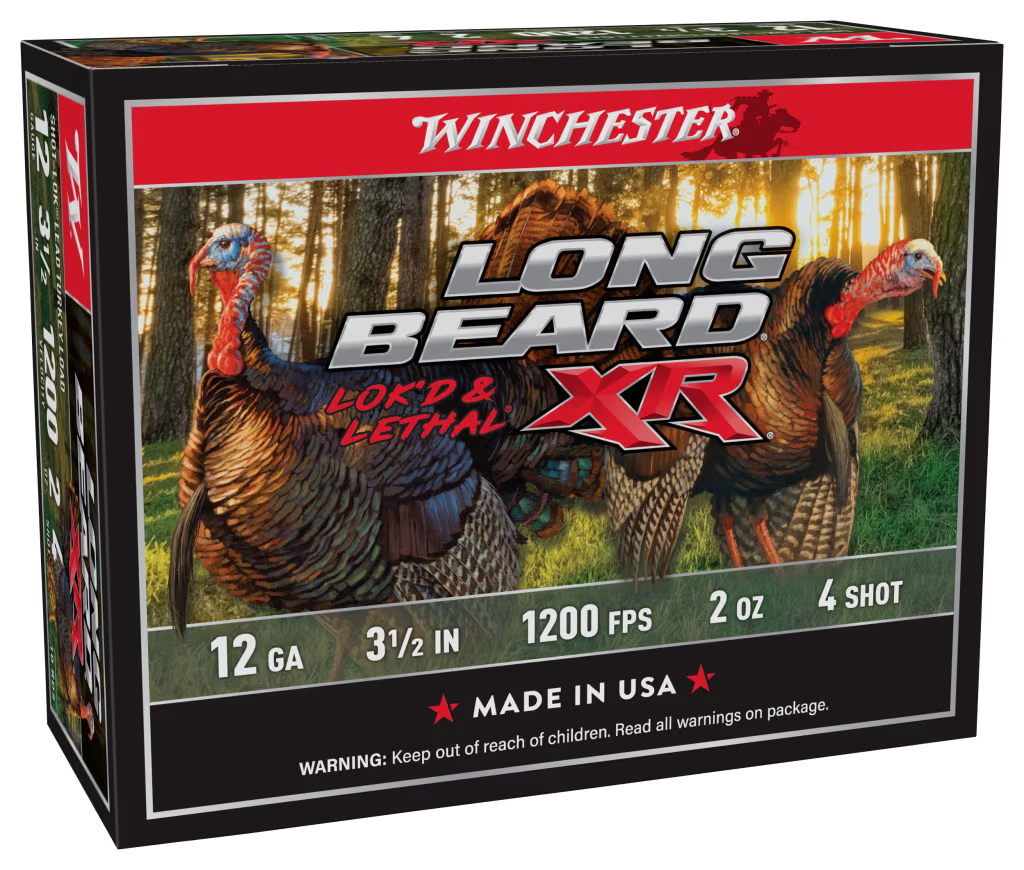
- Available Gauges/Shotshell Size: 3 ½-, 3-inch and 2 ¾-inch 12-gauge, 3-inch 20-gauge
- Payload: 12-gauge, No. 4, 5, and 6, 1 ¾-ounce loads at 1200 fps and 20-gauge No. 5 and 6, 1 ¼-ounce at 1000 fps
- Available Shot Size: 4, 5, and 6 shot (12-gauge), 5 and 6 shot (20-gauge)
- Shot Material: Lead
- Price: $35.99-42.99
Several years ago, Winchester engineer Steve Meyer was watching a batch of home-made hard candy set up when he had an inspiration. He theorized that you could pour molten resin into a shotcup full of pellets and let it harden, not unlike hard candy, it would encase the entire payload. When you fired the gun and the recoil shattered the resin, Mayer thought, it would break into flakes of a buffer that protected every pellet from keeping it round and flying true. Long Beard worked exactly as he imagined it would, and all of a sudden, all other lead loads were obsolete. Long Beard adds yards to lead effective range while remaining much more affordable than high-dollar tungsten-iron. It comes in both magnum (heavier payload) and high velocity. Although increasing velocity should open patterns, I’ve found the HV to be great loads. I’ve also seen it shoot great patterns with all sizes of shot, and I’ve killed turkeys with it, too.
With the right choke, it’s a 50-yard shell in most 12-gauges, and a 40-plus yard shell in 20s. If I had to give up my hoard of TSS and hunt with lead only, I wouldn’t feel sorry for myself at all if my gun was loaded with Long Beard.
Apex Turkey

Key Features
- Available Gauges/Shotshell Size: 3½-, 3-inch and 2 ¾-inch 12-gauge, 3-inch and 2 ¾-inch 20-gauge
- Payloads: 2 ½-ounces (10- and 3 ½-inch 12-gauge) and 2 ¼ and 2 ounces (3-inch 12), 1 ⅝-ounces (16-gauge) 1 5/8 ounces (3-inch 20-gauge), 1 ½ ounces (2 ¾-inch 20-gauge), 1 ⅜ ounces (28-gauge) 27/32 ounces (.410) in shot sizes: 7 ½, 8, 9
- Shot Material: TSS
- Price: $57-84 per 5
Back in 2017, boutique ammo-maker Apex became the first company to offer commercial TSS turkey loads. They handload every one of their high-performance shells then, and they still do. From what I see in my guns, that extra care pays off. Again, my results and your results will vary, but for me, nothing beats the patterns Apex shells shoot in my 12-gauges. I am especially fond of the 2 ¼-ounce 3-inch 12-gauge load of 9 shot, which puts 300-350 hits in a 10-inch circle at 40 yards in my 870, and a few less in my 835. Those shells work as well in the field as they do on paper.
The “Turkey” line comes in a black and brown box and contains only loads of all one size shot. Apex also makes blended loads, but in their “Ninja,” “Mossy Oak Greenleaf” and “Small Batch” lines.
Boss Tom

Key Features
- Available Gauges/Shotshell Size: 20-gauge 3-inch
- Payloads: 2 1/16-ounces in 3-inch 20-gauge 7 or 9 shot
- Shot Material: Copper plated TSS
- Price: $60 per 5
Somehow, the geniuses at Boss figured out how to fit 2 1/16 ounces of TSS, plus buffer, into a 3-inch 20-gauge hull. This is a ridiculous amount of shot for a non-12-gauge gun and far more shot than any competing 20-gauge load I’m aware of. The pellets are copper-plated, too, which does nothing to make TSS harder, but does help the shot flow through a choke (same is true of buffer).
The velocity is low, at 1050 fps, but so what? Turkeys aren’t supposed to be moving when you shoot at them, so leads due to lower velocity isn’t a problem. And, TSS retains energy so well due to its density, that you don’t have to drive it fast to begin with. The 20-gauge load contains 382 pellets of 7 shot, or 747 9s. In the right gun and choke, the patterns are as good or better than what you’ll see from many 12-gauges. You’ll feel these shells go off at the pattern board if you try them in a lightweight 20, but a little pain is worth such impressive performance, and you won’t feel at all in the woods.
Final Thoughts:
Turkey hunting is a tactical game with a wary opponent. You may only get a brief window to take a shot at a tom hot into the call. When the opportunity presents itself, having the best turkey ammo is crucial. In our testing, these loads patterned consistently, had adequate range, and went bang every time. While there are plenty of turkey loads on the market, we can confidently say these are the best turkey loads for any budget and any conditions you might find in the turkey woods.